
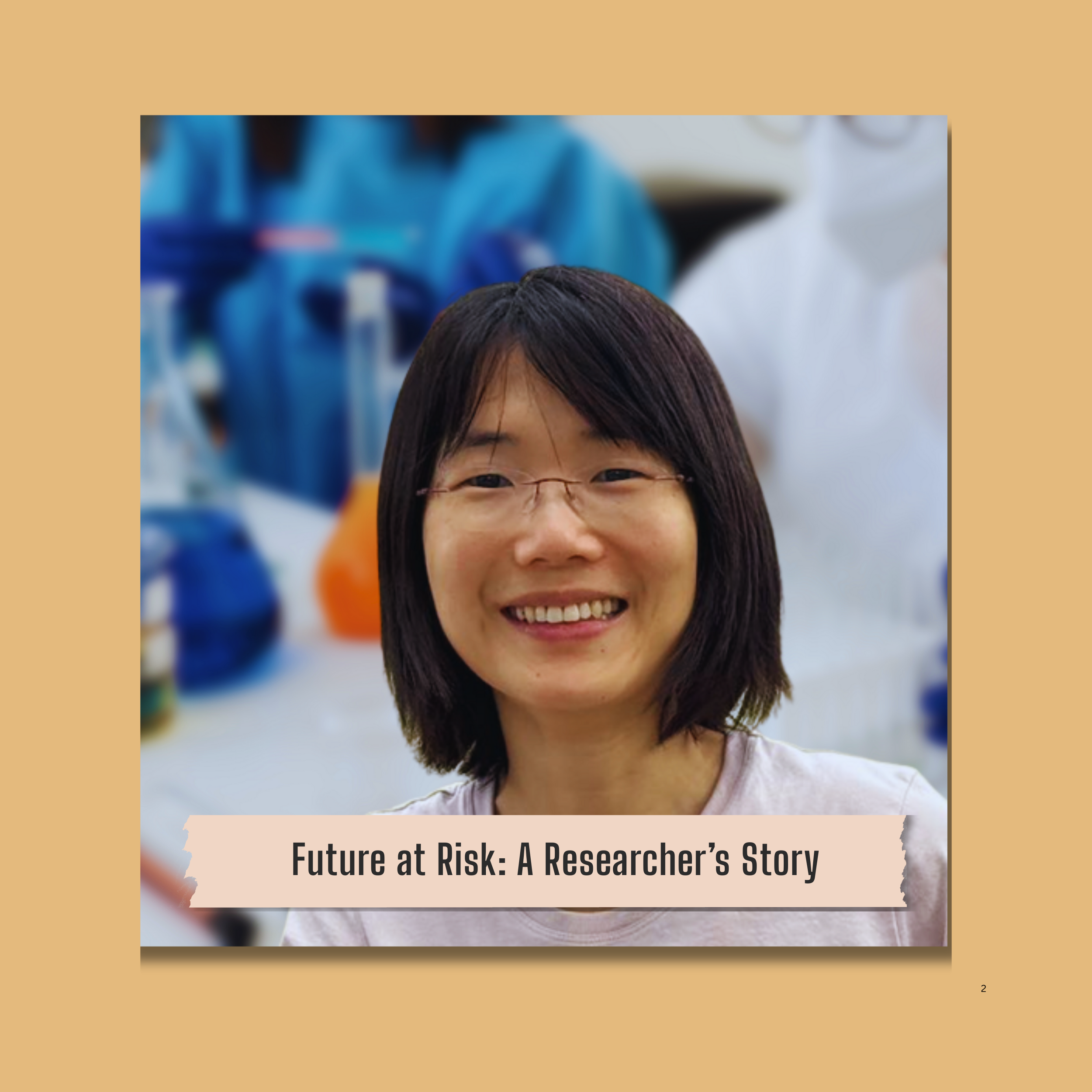
Future at Risk: A Researcher’s Story
Live from Stage 4 | Episode # 8| 12/09/2025 | Interview
Listen to full episode :
Guests
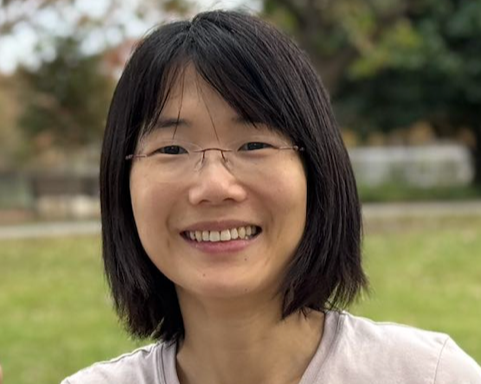
NA ZHAO, PH.D.
Assistant Professor, Lester & Sue Smith Breast Center, Baylor College of Medicine
Research Vision & Innovation
Aberrant gene expression is a hallmark of cancer, yet mRNA abundance explains <50 % of the variation in protein output. This gap underscores selective mRNA translation as a fundamental yet under-explored layer of oncogenic regulation. My long-term program tackles two questions:
(1) How do breast tumors rewire translational machinery to drive progression and evade immunity
(2) How can we therapeutically exploit these translation-centric vulnerabilities?
My approach: Leveraging ribosome profiling, spatial-omics, immunocompetent mouse mammary tumor models, and patient samples, my lab maps translation dependencies across every stage of tumor evolution to nominate actionable targets. This effort is powered by an NCI K22 Award and a Susan G. Komen Career Catalyst Research grant
Career updates after the recording of this episode
Baylor is working to transition Dr. Zhao into a tenure-track assistant professor position.
BCM (Baylor College of Medicine) is experiencing serious financial challenges, resulting in limited startup support for Na.
Despite these challenges, Na remains optimistic due to several grants from foundations such as Komen and Mary Kay Ash, and hopes her NIH career grant will be activated.
Na is confident she can make progress in her new role.
The CPR clinical trial grant was recently funded, enabling a phase one trial in metastatic triple negative breast cancer patients.
Quick Summary
In this episode we get urgent and personal: with deep cuts to NIH and NCI funding threatening labs, jobs, and future treatments, what happens to science — and to patients — when the pipeline is squeezed?
To make that real, we’re talking with Na Zhao, a research assistant professor at Baylor College of Medicine. We follow Na’s experience as she navigates a pivotal moment in her research career. Facing institutional financial challenges and limited startup support, Na remains undeterred, leveraging multiple foundation grants and the potential activation of her NIH career grant to continue her groundbreaking work.
Through resilience and determination, Na exemplifies the spirit of scientific progress in the face of adversity, offering hope for the future of cancer research and patient care.
This episode drops on the first day of the San Antonio Breast Cancer Symposium, where thousands including Dr. Zhao gather to share breakthroughs even as funding uncertainty looms. In this episode, we dive deep into the real-world impact of research funding cuts on scientists, patients, and the future of cancer care.
Wee’ll explore the struggles junior scientists face, the importance of advocacy, and why supporting research is crucial for everyone touched by cancer.
Whether you’re a patient, advocate, or simply passionate about science, this conversation will open your eyes to the human stories behind the headlines—and remind us all why the fight for research funding matters.
Let’s get started.
Key Takeaways
Personal Motivation and Background:
The guest, Dr. Zhao, became a scientist due to a strong family history of breast cancer, losing her mother and aunt to the disease. Her personal experiences drive her passion for research, especially in metastatic breast cancer.
Challenges in Academic Careers:
Securing a faculty position in academia is highly competitive and can take years, especially for junior scientists. Even after receiving a job offer and a grant, Na’s opportunity was lost due to institutional funding uncertainties.
Impact of NIH Funding Cuts:
Proposed cuts to NIH (National Institutes of Health) and changes to indirect cost funding have a cascading negative effect on research institutions’ ability to hire and support junior scientists.
Indirect costs are crucial for providing startup packages and bridge funding for researchers between grants. Without these, institutions are less able to hire or retain talent.
Broader Consequences for Science:
The reduction in available faculty positions and research funding leads to a “brain drain,” with talented scientists considering leaving the country or academia altogether.
Graduate students and undergraduates are also affected, struggling to find labs and opportunities, which threatens the future pipeline of researchers.
The Role of Federal Funding:
Most early-stage, high-risk, and innovative research is funded by government grants, not by pharmaceutical companies or startups. Without federal support, many promising therapies would never reach patients.
Research Focus and Progress:
Na’s research targets triple-negative breast cancer, exploring novel therapies that inhibit protein synthesis in tumor cells, showing promising results in preclinical models.
Despite scientific progress, lack of resources limits the ability to pursue deeper investigations and prepare for clinical translation.
Optimism and Resilience:
Despite setbacks, Na and her colleagues remain optimistic, supported by mentors and the scientific community. There is hope that advocacy and public awareness can influence policy and restore funding.
Importance of Advocacy:
Patient advocates and the broader public play a crucial role in communicating the importance of science and research funding to policymakers.
Scientists urge advocates to make their voices heard and emphasize that investment in research benefits everyone.
Alternative Funding Sources:
Nonprofit organizations provide some support, but their grants are smaller and cannot replace federal funding.
Encouragement for Future Scientists:
Despite the challenges, Na encourages young people (including her own children) to pursue science, highlighting the fulfillment and impact that comes from discovery and helping others.
Progress in Cancer Treatment:
Advances in research have already turned some forms of breast cancer into manageable chronic diseases, and there is hope for continued progress, though a complete cure remains elusive.
Overall Message:
The episode is a powerful discussion about the personal and systemic challenges facing cancer researchers, especially in the context of funding cuts. It highlights the essential role of federal support, the resilience of scientists, and the importance of advocacy to ensure continued progress in cancer research and treatment.If you’d like a more concise summary or a version tailored for a specific audience (e.g., patient advocates, policymakers), let me know!
-
[00:02:35] Victoria: NA, it's so wonderful to have you with us. I'm so happy to have you here, and thank you so much for agreeing to talk to me. Thank you for inviting me.
First, I like to thank you for this opportunity. And second, I appreciate that you care about
[00:02:53] Na: the NIH
the, NIH cuts. At first all the scientists were worried that we were alone, that nobody cares.
Really delighted to hear that patients and patient advocates like you deeply care about this issue.
[00:03:07] Victoria: Well, of course, we care about our future. This is our future. It may not affect us, those who are already living with the disease, but it will certainly have an impact on those who will be diagnosed after us.
So we do care. There is a growing support among the nonprofits and the volunteers. We're all writing letters to our Congress people and saying, please, please stop this nonsense. I'm a big fan of yours. After an article that you published in science, and you had me at the opening line when you said, and I'll quote you.
It took 30 minutes for my carefully constructed future to crumble. And for me, and for everyone who is living with stage four breast cancer, we're all too familiar with this particular line. this opening line would've been an opening line for all of us, but of course, you are talking about something else and 30 minutes means something else to you.
[00:04:10] Na: Okay, I wanted to start from the very beginning. .
[00:04:13] Victoria: The best place to start.
[00:04:16] Na: Yeah. I grew up in a small town in China.
My family, my father and my mother, they run a modest cloth shop, so they make a living by selling cloth. I had a very happy childhood until when I was five years old my mother was diagnosed with breast cancer and six years later she died from metastatic breast cancer.
I was 11 years old. And actually, when I was nine or 10 years old, my aunt from my mother's side also died from metastatic breast cancer.
[00:04:55] Victoria: So you probably have a mutation, right?
[00:04:57] Na: I got tested when I came here for postdoc in 2015. There was no known mutation found in my genome, but we still cannot rule out the possibility there are some hidden genes that are not caught by the panel.
So go back to when I was little. At that time, nobody in my family had the
experience .
Nobody in my world does science or medicine. And actually I'm the first college student in my extended family. , When I chose major for the college, I chose biology.
And then in my undergraduate studies, I met my future PhD mentor and I joined her lab. At that time, I was studying liver cancer, but I fell in love with research. In 2015, after I finished my PhD in China, I came here as a postdoc , and I chose breast cancer as my research field.
I have a strong family history. I want to understand the disease. The hope is that in the future if I will be diagnosed with breast cancer, I can get
an effective
treatment and that I can see my children graduate from college.
When I graduated from college, I really hoped my mother could be with me and when I became a mother on my first Mother's Day celebration. I miss my mother so much. I, I thought she would be thrilled to meet my baby. It's just the hope that we can develop better treatment for patients.
, So this is personal to me. I really want to do the research and I think the best way to do research is stay in academia, to find a faculty position. So during my postdoc and then later on, as instructor I published solid papers. I think I'm ready for a faculty position. So I search for faculty positions.
Only few people can secure a position
during the first year of job search. It is very typical for a researcher to take two years to finally secure a position because of the competitiveness of the faculty market. So it took me two years and finally I got a job offer. I was beyond happy. And also at that time, I got an intent to fund notice from the NIH.
They are willing to fund me under the condition that my future institution could contribute sufficient amount of startup fund to support my research. So actually, a lot of things happened early this year, I got a notice of intent to fund for my career development award. I got job offers.
But all of them turned bad within 30 minutes that morning. At first I received an email saying they're rescinding the offer. And then 12 minutes later, I had a scheduled call with my program officer at NIH.
And on that call, I got first aware that, a support from my future institution is crucial to activate the grant. Without enough support from my future institution, the NIH will not give me the money to start my own lab.
I didn't
know how
to make sense of it. Yeah. I
didn't
cry. I guess when you are able to cry, you already understand the situation. At that time, I didn't understand what was happening. I was so
confused .
I felt the whole world is spinning around me and I felt so dizzy. I
I wrote the article that night and just trying to make sense: what's happening, what's the cascade of the events?
[00:09:19] Victoria: Do you understand
it now? And what's happening with you now after those 30 minutes?
[00:09:26] Na: My backup plan was to stay at Baylor. But again, without a definite answer from the Congress and from the NIH, Baylor's view is that, they won't be willing to spend because they have to prepare for rainy days,
right? I
guess this NIH cut is having profound impact on all the scientists, but especially for junior scientists.
It already takes long for junior scientists to secure a position, and then this uncertainty, this cut really make it more difficult for anybody to secure a position,
right? I can
give you an example. Last year, 2024 by August, if you go to nature jobs or science careers where institutions post faculty positions for cancer research related positions, you can easily find 50, 60, 70 positions.
At the same time, this year, less than five or less than 10 positions were available. So early August is the beginning of the job season and institutions begin to post job positions. So we will be in dire position to secure a job this year if nothing improves at NIH.
To be honest, before they proposed the cut to indirect cost I didn't know what indirect cost. is used for. I have only vague ideas. I know they pay for some overhead, but now I know for example, for junior faculty,
The
startup package comes from this indirect cost. The departments gather those indirect costs and they put the money together and then they can use it for a startup fund for their future hires.
So this is really crucial. This gives t he institution, the flexibility to recruit and to support people .
As a result, nobody is going to hire because they don't have the money, they simply don't have the money to hire junior scientists. For us, when we are at this stage, we haven't accumulated enough preliminary data yet to apply for the major grants.
So without this support, it's not possible for anybody to accumulate enough data to get major grants on their own. So this causes a cascade events. Without this money.
[00:12:09] Victoria: Right. No, I get that. For us to understand better how this cascade works.
Maybe you can just explain how research is funded and what are the steps in the process of research? 'cause you mentioned a lot of important things, and maybe, we need to break it down a little bit.
[00:12:28] Na: Okay. Yeah.
First, research is expensive, and second research actually is not always very efficient or effective.
And so , it takes a lot of trial and errors to find the best approach to tackle a scientific question. So as a result, research is heavily dependent on federal grants. And those big Pharmas, actually, they seldom invent new drugs on their own. Most of the times they buy what's available from the lab, which took decades to develop, and then they further market it, develop it.
But most of the inventions at the initial stage actually come from a federal grant supported labs. So, the government funds research, there a hope that the research findings can be translated and later on the big pharmaceutical companies can take over and market it, and the patients can receive the treatment.
It's really crucial to have this government funding to support the initial stages of therapy development. So what I did, is I tried to develop therapy that can target metastatic breast cancer. I did receive a small amount of funding from a small biotech because I was using their drugs.
The drugs they developed, I was testing in my mouse models and I was studying the mechanism biomarkers, but the majority of research founding came from the government. And without this founding, I was not able to do my research.
[00:14:24] Victoria: Can you tell us a little bit about your research?
[00:14:28] Na: Yeah.
I have tried different strategies to target triple negative breast cancer,
the subtype I was focused on. First, I tried some epigenetic therapy. We should reprogram the transcription of the tumor cells. It didn't work well actually. And then I tried other, and then like five years ago, I turned my eye into this strategy targeting the protein synthesis process.
I mean, tumor cells need to survive and they need to produce a lot of protein that are crucial for their survival. And if we can block or dial down the tumor promoting protein production process, you can kill the tumor cells. And actually normal cells, there are less impacted.
Normal cells can cope, but tumor cells will crash and they're fairly good selectivity against tumor cells.
And not only that, a bonus is that when you are tweaking the protein production in the tumor cells, sometimes it produces protein in the tumor cell that can tag them as a dangerous signal that can attract immune cells to further attack the tumor. So you're tweaking this protein production machinery you have, on one hand directly curbing the tumor growth.
On the other hand, you're able to activate the immune system to further attack the tumor. So in our collection of immunocompetent mouse model we've observed remarkable effect from the therapy alone and more so when combined with standard care chemotherapies. You know, for TNBC chemo chemotherapy is still the cornerstone treatment.
Importantly, not only in primary tumor study, but also in metastasis, including lung metastasis and more recently liver metastasis. Okay. It seems, especially for liver metastatsis, they're more dependent on this pathway. When you inhibit this pathway, the effect is even more dramatic than compared to the primary tumor.
I have been working with those models for years. I've never seen anything like that. I felt this is really a promising approach and so I really want to propel my research. I wanna dig further, dig deeper to explore the mechanism, to explore the biomarker, to explore the potential resistance mechanism.
But now I just don't have the resources to do all the things I wanted to do
Chapter 2
[00:20:46] Victoria: on July 31st, the Senate Appropriations Committee approved a new spending bill for next year. In this bill, they're bumping up the budgets for the NIH and NCI an extra $400 million.
$400 million for NIH and 150 million more for NCI. Is this good news for you? And what do you think will happen , downstream.
[00:21:15] Na: Is definitely good news, but it's simply not good enough. But the increase does not meet the inflation, especially in scientific research, the inflation is much higher than the inflation in everyday life.
The equipment, the reagents we're using, the air price increased much more than this increase
especially at the National Cancer Institute. The
pay line
has been dropping year after year, after year. What that means is that scientists still have to spend more time instead of actual research, on securing a grant.
I think this is really a waste of time, even for me. I think eventually with my background application grant record, I will secure position, but it's the waste of time. You have to reapply. Yeah. You have to go through this job hunting again.
Instead of doing the research, you have to do all of this. This is really a huge waste of time.
I'm not sure whether you understand
[00:22:19] Victoria: What does it mean?
What is pay line?
[00:22:21] Na: So example, if a 10% pay line, that means only the top 10% applications will be funded. If the pay line is 20%, that means the top 20% applications will be funded. The pay line at NIH, especially at NCI, is dropping year after year from 18% to 15% to 12%, and then to 10%. With the proposed cut, it'll be 4%. Luckily, they didn't pass it.
I think the pay line will be kept at 10%. 10% means for every 10 applications, only one of them will be selected for funding. To prepare for a grant application it takes months for a researcher to submit a grant. With this pay line,researchers have to submit multiple applications in order to hopefully get one, to be able to survive. So that will take a lot of their time in the grant submission.
[00:23:35] Victoria: I see. But you mentioned in the beginning, and I wanted to follow up on that. You said that , for the work you do and for the research, your place is in academia.
But what about going into the pharma? Is that something that people do and why wouldn't that be an option for you?
[00:23:56] Na: First of all, I think pharma, they are a for-profit companies.
I would say , when something is showing a big promise then they quickly jump into it, but before that, they wouldn't do anything. They are
at later stage of drug development. The most seminal findings almost always come from the lab, the early concept, the proof of concept experiments. And most of them come from the labs. And also in the lab, you really have the freedom to decide your own research direction. I think that that freedom, the flexibility is keeping me in academia.
[00:24:40] Victoria: What about the startups? A while ago I was invited to visit a small biotech startup, and it was really exciting to see what they were doing. But again, they were having the same, the same funding problems. Do you have a lot of friends who have gone into the startups
what's happening there?
[00:24:59] Na: Yes.
So I received one of the investigational drugs from a small startup. Are they still around? No, it was permanently closed a year ago. They had two pipelines, one pipeline not the drug I am investigating on, the other pipeline actually failed a clinical trial and that caused a company to close last year. So there are a lot of uncertainties in small biotech.
Yeah.
A lot of them are business decisions. It's not related to science. It's more business management.
I'm not sure how much I'll be involved in the scientific portion if I join a small startup. And also, I would say a lot of the findings, they don't happen in a planned way. They're doing experiment, and all of a sudden you notice something unusual, and then yes, you dig further, then you find this is a new avenue to attack the issue.
A lot of things cannot be planned. I think for companies, either small biotech or big pharma, they're doing things in a more rigid way. They don't have a lot of interest in those unexpected findings, I would say.
[00:26:21] Victoria: Right. No, that's true. And that's what drives research I get it.
[00:26:27] Na: I think that's what keep the companies more effective. They're purely on a planned route to the product development, but as research
They're more open-minded, I would say.
[00:26:41] Victoria: Yeah, no, that makes sense. You mentioned, let's talk about this. You did mention that you are not alone in the situation, that you have a lot of friends, junior scientists who face the same problem. So of course the first thing that comes to mind is brain drain, right?
What happens when, a promising scientist like you cannot land a job here and apparently there are opportunities outside of this country. Does this worry you and have you thought about this yourself going somewhere else? Definitely.
[00:27:15] Na: I have thought about going back to my home country China.
But my husband is really happy with his current job, so we think we should perhaps stay. But I know one of my friends, she got her master in Germany and then she came here for PhD and postdoc. She also searched for job this past job season. She had wonderful resume. She had wonderful publications.
She had a fundable score for a grant, but she was not able to get any position. This is really unusual ,, in the past, she would get multiple offers, I'm sure. So what she did was she was submitting her resumes to the German institutions. That will be a reality.
If people cannot find positions, they either leave academia or they go somewhere else where they can start their own lab.
[00:28:15] Victoria: That seems like a serious problem because even though you work on your own this is more of a team sport, right? Yeah. You need the community of people, like-minded people who are doing similar stuff to move your research forward.
Yeah. Is that something that worries you?
[00:28:37] Lena: Yeah, every scientist in my department , they're worried about their future, they're worried about the lab. And so every year at Baylor, we have incoming graduate students In the past,
they'll quickly be absorbed by the different labs. But this year they have real trouble to find lab for rotation because very few labs have a stability, or the predictability of future findings.
Most labs, they just don't have the funding or they just cannot predict whether they'll have enough funding. I would say this year is very different from the past. The students are struggling to find a lab to rotate in.
[00:29:21] Victoria: So is it's like a cascade effect, right? Yeah, yeah. You start, you start with the undergraduates.
The undergraduates come in, they can't find internships, they don't know what field to go into. And then the graduate students, there are fewer graduate students because there are not as many places and that just goes on and on and on. The future, that's where the problem is gonna be.
Maybe not right now, but the future. Yeah. Um,
[00:29:48] Na: yeah,
[00:29:49] Victoria: It's frightening. And do you still feel optimistic? Do you still feel that there still a sense of optimism for the future, or it's becoming bleaker and bleaker?
I don't know how people feel about research about science. I know there are a lot of misinformation, but after the Senate, not only, they didn't agree on the cut, they also increased. But I'm really feeling optimistic,
[00:30:20] Na: I think the general public and also, especially patients and patient advocates.
You're really doing a amazing job letting Congress know that what they're doing is crucial , for the future to find a cure.
[00:30:33] Victoria: You have mentors and establish scientists you work with? What advice do they give you? .
[00:30:40] Lena: My mentor is Dr. Jeff Rosen. He is the most supportive, mentor any trainee can hope for. , He's a very cautious person in general, but under challenging circumstances. He is the most optimistic person. He always stay positive. He just tell me that I should, hold on.
I should. Keep doing what I'm doing now while I still have the bench, I still have some money left to do my research. I should just keep doing what I do and hopefully things will get better. I think we have to stay positive. There's nothing else. We cannot control things that are outta our control.
There are a lot of, things that cannot be predicted. . But what I can do is do doing what I have
[00:31:35] Victoria: control Of. you said that those 30 minutes were frightening and, you felt dizzy the world was spinning. I know that feeling very well, but how are you now?
How are you coping?
[00:31:51] Lena: I'm much better actually. I think the brain has a self protection
Mechanism. I try to forget what happened and I have supportive mentors. I have, other senior scientists that are very supportive.
And after my article was published, I received , a lot of warm notes, not only from people I know, but also from many strangers. Did you get any job offers? Well, one of the, one of the institutions who went silent after the proposed NH cut. I was reading to reconsider my application.
[00:32:30] Victoria: Hmm.
[00:32:31] Lena: That's promising. I believe something good will happen. As more and more people are aware of the di consequences of the proposed cut, when people speak up, then the Congress understand. What's happening at NH is detrimental to generations of scientists and patients.
When people act, I think things will get better.
[00:32:59] Victoria: Are there other venues, so NIH as you mentioned, is the main, source of grants. But are there other venues, like nonprofits, that you could go to and, , apply for grants?
[00:33:14] Lena: Yeah. Luckily for breast cancer, we have a huge. Breast cancer patient populations and many wonderful non-for-profit organizations, including Susan G. Coleman, breast Cancer Research Foundations, and even Mary Kay Ash Foundation, are nice additions.
Most of them , are smaller grants, right? For two years and with smaller amount per year. So they are really nice additions, but they still cannot replace ih. Have you noticed
[00:33:49] Victoria: any increase in, , grants? From, uh, foundations, foundations , did they step up?
[00:33:59] Lena: I'm not completely sure, don't think they have the capacity to significant increase the number of grants they can support. I think , the most recent grant I submitted is February 1st. That's just on the day of, um, IH proposed cut.
I didn't track how it changed after the NH cut, but my prediction is they won't. Significantly change because they're not able to raise significant more money in a matter of few months., So it, it will take time for the foundations to
React.
[00:34:36] Victoria: , This is a question that may be difficult to answer, but I want to ask you, if you had a chance to speak in front of the Senate, what would you tell them?, And as a follow up, , what's your message for us patient advocates? What would you like us to do to, help this situation improve?
[00:35:00] Lena: We come to science not because of many scientists. Never make the most money. It is not a profession for profit. We choose to become researchers because we love science and we want to do our part to make the world better and to know more about ourselves, about human beings. And the United States is the greatest country in the whole world.
They should do something great for the human being, but not alone. What we do are benefiting everybody. For example, for breast cancer, one of eight women in their lifetime will develop breast cancer almost. Everybody. If you have family members or friends develop breast cancer in your lifetime, what they're doing is making human life better and they're not asking for that much.
The budget and it should receive is tiny portion of the defense budget. We should spend more money on building something instead of destroying. Yeah, destroying something.
[00:36:34] Victoria: Yes. I love, what you said. It's a beautiful quote.
Now , let's talk about your message for us patient advocates. What would you like us to do more? How can we help?
[00:36:45] Lena: We are on the same boat. Yes, we are together.
We have to make our voice heard. , We should talk to whomever we meet with. Talk about, why we need science, why we need NIH, why we need to support scientists.,
It should be , common sense in the society that science should be valued and scientists should be respected. Eventually
Everybody will have a chance to benefit from the scientific discoveries.
[00:37:28] Victoria: Yes, it's beautiful. Thank you. Okay, so my last question, I want to end on a hopefully optimistic note. So, would you tell your children to go into science? Would you still encourage , your children to go into science? Of course. I think
[00:37:50] Lena: scientist is the best profession and anyone can dream of. You can do whatever you're interested in.
You have the freedom, you have the flexibility. You are your own boss. That's the best, right? Yeah. Yeah. And you really have this sense of fulfillment, they discover something, then you are the first person in the world to know something. It feels amazing. I think money cannot bring you this amount of joy, of discovery .
And then when you see your, , research, translated into the clinics, then it can benefit more people. This sense of achievement, sense of fulfillment. Nothing else you compete with, I think.
[00:38:51] Victoria: I think that is so well put. And, uh, thank you so much. I wish you luck. And I want you to keep us posted on what's happening with you and we will be following you
[00:39:05] Lena: thank you. Thank you for the invitation. I really enjoyed our conversation.
[00:39:09] Victoria: I hope you stay here and not go back to China.
[00:39:12] Lena: Yeah. I think I stay here
[00:39:14] Victoria: I hope,. I'm sure actually, I don't say, I hope, I'm sure something will work itself out that has to because what you are doing is, uh, you're giving us a lifeline and they can't take it away from us. Well,
[00:39:29] Lena: yeah, I would, yeah. Many times I, I was struggling to say whether we are that important.
But I think yeah. I myself represents a generation scientist. I think they are important
[00:39:42] Victoria: Of course. You are important . Yeah. Listen, I have, uh. Her two positive cancer. And I was first diagnosed with early stage in 2004, and in those days it was the worst possible diagnosis to have the worst.
And now because of Herceptin, because of Projeta, I'm here in my 12th year of being metastatic. So yes, what you do is crucial, and I hope you can continue doing what you do and I would love for you to come back and talk to us about science. Thank you. You're not growing up in a culture. We don't
[00:40:23] Lena: really brag about ourselves.
[00:40:25] Victoria: Oh, I know. I know. , As women, we don't. I'm like you, I wasn't born in this country. I was born in Russia. So we have very similar background And in the culture, you and I grew up, . It's not considered a good thing to brag about yourself, but I think you can absolutely brag about yourself.
[00:40:46] Lena: Yeah, I think I will do that. It is, we should advocate for ourself. Everybody should.
More on Na’s Article in Nature Magazine
Read it here.
Summary
Na recounts how a newly accepted tenure-track job offer was rescinded due to university budget shifts and federal funding uncertainty, upending plans already strained by dual-career and family responsibilities. After a long, difficult job-search and grant-writing process, the loss forced her to confront practical dilemmas (spousal employment, childcare, startup funding) and emotional responses. Despite uncertainty about activating an NIH K award or securing a lab, she resolves to continue doing science, care for their family, and persistently pursue grants and opportunities as an act of resilience.
Main takeaways
- Academic career progress can reverse suddenly due to institutional budget decisions and shifting federal policy.
- Funding requirements (external grants) and university indirect-cost concerns heavily shape hiring outcomes.
- Dual-career and parenting realities add major practical constraints to academic moves and decisions.
- Even a fundable grant may be unusable without sufficient institutional startup support.
- Emotional tolls include anxiety, sleeplessness, and the need to balance career ambition with family commitments.
- Perspective helps: larger tragedies reframe personal setbacks and can foster acceptance.
- Practical resilience = continue doing the work (research, grant writing) and seeking options while managing family duties.
- Outcomes remain uncertain, but persistence, flexibility, and incremental efforts matter.
.
More on Na’s Research
Imagine a factory where DNA is the instruction book, mRNA are the blueprints, and proteins are the finished products that keep a cell working. In some aggressive breast cancers called triple-negative breast cancer (TNBC), that factory goes haywire — not just at the blueprint stage, but in the step that turns blueprints into products. We studied a drug called zotatifin that interferes with a key “starter” protein the cell uses to make other proteins.
When zotatifin slows that starter, two things happen. First, the cancer cells stop making proteins they need to grow. Second — and unexpectedly — the cells start to sound an alarm from inside: they build up double‑stranded RNA, which the cell mistakes for a viral infection. That triggers a strong antiviral response, releasing interferon‑beta and switching on many immune‑related genes. In plain terms, the tumor begins to call the immune system for backup.
In mouse studies, combining zotatifin with the chemotherapy drug carboplatin worked much better than either drug alone — and the immune alarm was a big part of why. Blocking that interferon signal made the combo less effective, showing the immune response matters. In patient‑derived tumor models, some cancers completely disappeared, others shrank, and tumors that already had higher interferon activity responded best. That suggests we might be able to predict who will benefit.
Bottom line: zotatifin not only blocks cancer cells’ protein production but also flips a switch that helps the immune system attack the tumor. That dual action — plus a possible biomarker to pick patients — makes this a promising approach to test with chemotherapy in future trials.
