
Developing Story: How PCDI Is Changing the Way We Think About Dosing
Listen to full episode :
Live from Stage 4 | Episode #048| 10/06/2026 | Developing Story
GUESTS
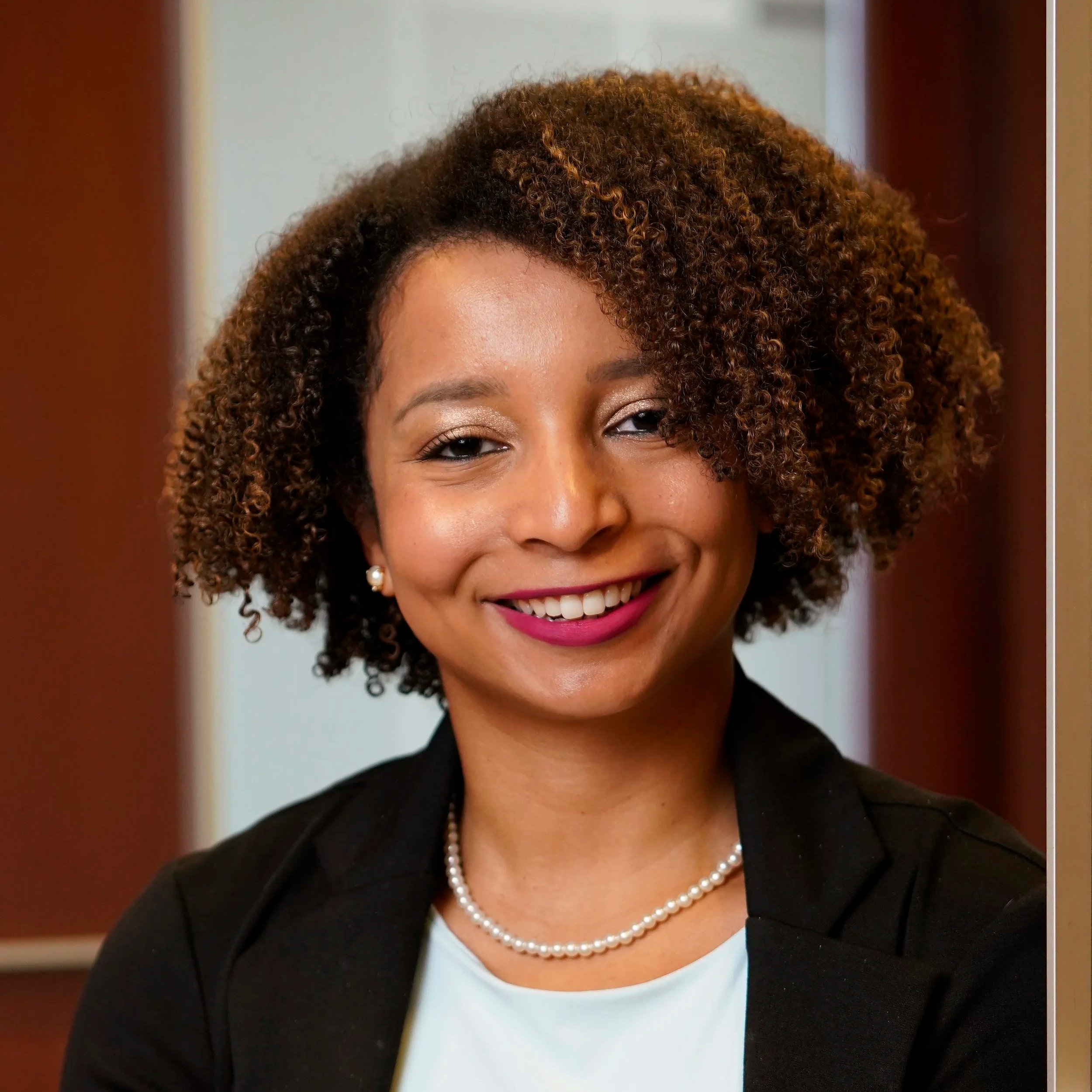
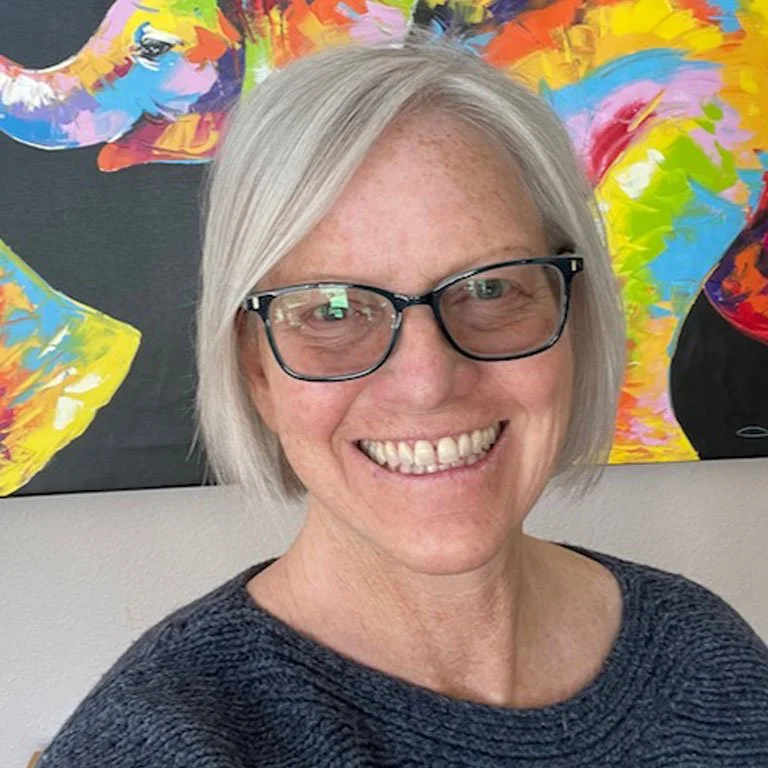

Dr. Mya L. Roberson, MSPH, PhD, is an Assistant Professor of Health Policy and Management at the UNC Gillings School of Global Public Health and a member of the UNC Lineberger Comprehensive Cancer Center. Her research as a social epidemiologist focuses on cancer care delivery, health equity, big data trends, and precision medicine access. She serves as Associate Editor for Diversity, Equity, and Inclusion at JAMA Dermatology and is a Trustee of the Brown University Corporation. She earned her BA from Brown University and her MSPH and PhD from UNC-Chapel Hill.
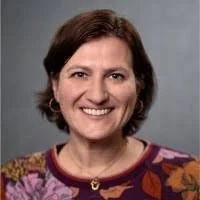
Dr. Elizabeth "Liza" Lerner Papautsky is an Associate Professor with tenure in the Department of Biomedical & Health Information Sciences at the University of Illinois Chicago (UIC) and a member of the University of Illinois Cancer Center. As a human factors scientist and breast cancer survivor, she applies human factors engineering to healthcare to investigate how patients and families navigate complex medical choices. Her research, funded by institutions like the NCI and CDC, focuses on patient decision-making, the cognitive burdens of home health management, and supporting young breast cancer survivors through community-led initiatives.
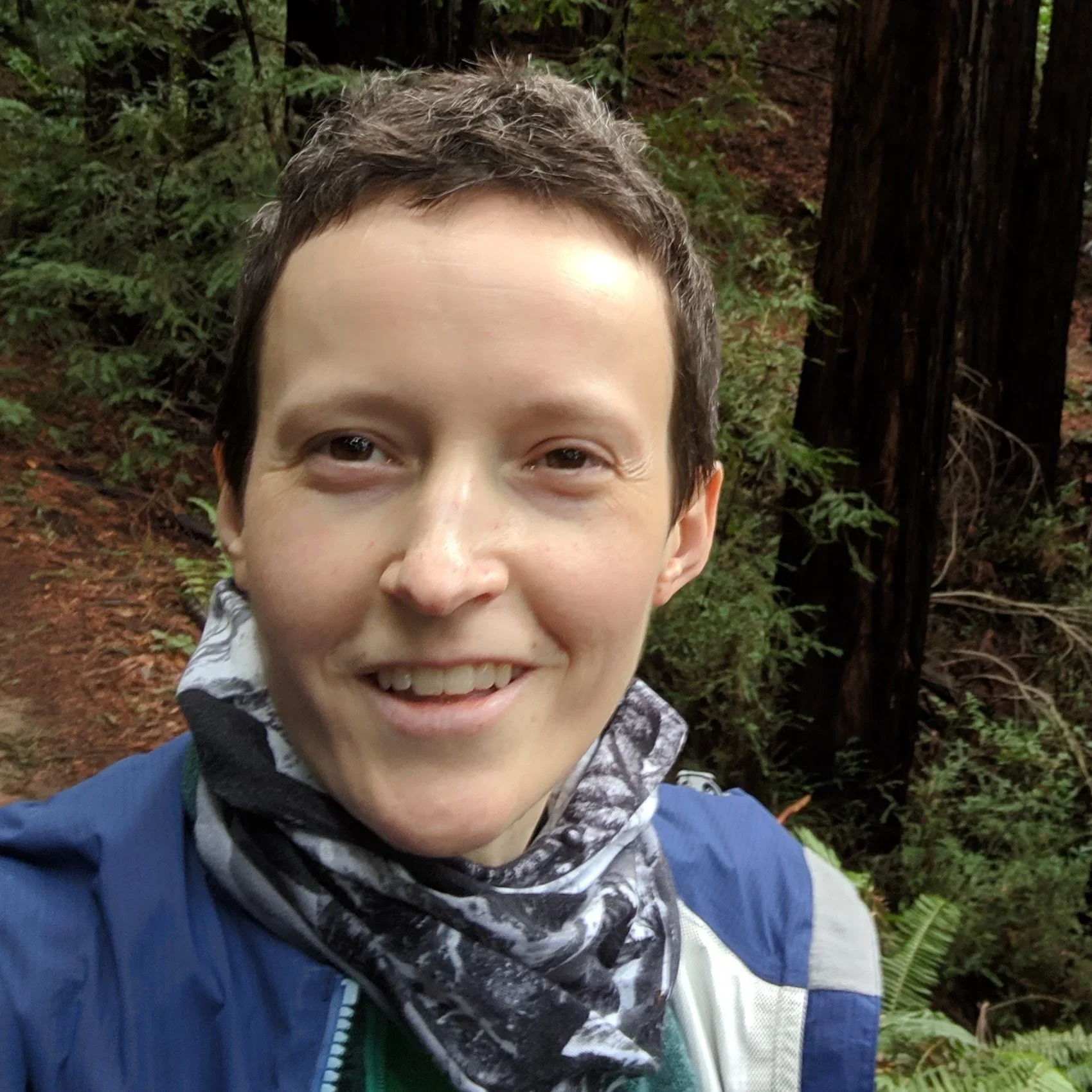
AJ Veach is a writer, podcast host, and health advocate dedicated to changing how we talk about serious illness and mortality. Following a successful career as an international journalist—including serving as The Wall Street Journal’s Asia Desk Chief—Veach transitioned into full-time advocacy after a metastatic breast cancer diagnosis. Today, through the Happy Death podcast, writing on Substack, and leadership roles with organizations like METAVIVOR, Veach champions patient-centered care, dosage transparency, and honest conversations about living fully in the face of life-limiting illness.
Dr. Kelly Shanahan, MD, is a dedicated metastatic breast cancer advocate, research reviewer, and former OB-GYN whose personal journey transforms her clinical expertise into powerful patient-centered action. After a successful 22-year career in private medical practice, her own stage IV diagnosis in 2013 shifted her focus from treating patients to fighting for their lives on a national scale. Today, she serves as the president of the board of directors for METAvivor, collaborates with leading oncology organizations, and reviews federal research grants to ensure that the voices of those living with stage IV cancer directly shape the future of medical science.
Martha Carlson is a prominent metastatic breast cancer advocate, writer, and speaker dedicated to transforming the oncology landscape. Diagnosed with stage IV breast cancer in 2014, she uses her patient experience to bridge the gap between researchers and the cancer community. As a co-leader of the Patient-Centered Dosing Initiative, a columnist for CURE Magazine, and a host/producer of the Live from Stage 4 podcast, Martha champions clinical trial equity, patient-researcher partnerships, and treatment dosing strategies that prioritize long-term quality of life.
Summary
The Patient Centered Dosing Initiative was formed in 2019 by Anne Loeser and a team of MBC patient advocates. The team has changed over the years but has maintained its founder's firm stance that people with metastatic breast cancer form the core. The work is led by this core, with the support of a medical advisory board that includes well-respected doctors and researchers who support the cause of patient-centered dosing and treatment.
On their website, you can find links to more of this history and numerous papers authored by the PCDI, as well as resources that can help you better understand the importance of treatment dosing, management of side effects, and how to approach your health care team for a conversation on the topic.
It is important to remember to never make any changes to your treatment schedule without your oncologist.
Key Themes
The History of PCDI: How Anne Loeser's personal experience with side effects led to a landmark 2020 survey of over 1,000 patients and 100 oncologists that caught the attention of the FDA and influenced Project Optimus.
Real-World Dosing Practices: Most patients and doctors want more open conversations about dosing. Many patients are quietly reducing doses on their own, but this needs to be a collaborative decision.
Quality of Life Matters: Side effects like fatigue, nausea, and cognitive decline impact every aspect of daily living: work, relationships, self-care, and mental health.
Supportive Care Barriers: Patients face financial, geographic, and systemic obstacles to accessing medications and tools that can help them manage toxicity.
The Missing Voices: Despite efforts, survey respondents remain predominantly white and college-educated. How can PCDI reach patients who've been left out of cancer research?
Clinical Trial Design: The maximum tolerated dose standard was developed for cytotoxic chemotherapy decades ago. New drugs need new study designs that reflect real-world use and patient priorities.
The Two Surveys
1. ADC Survey (2025)
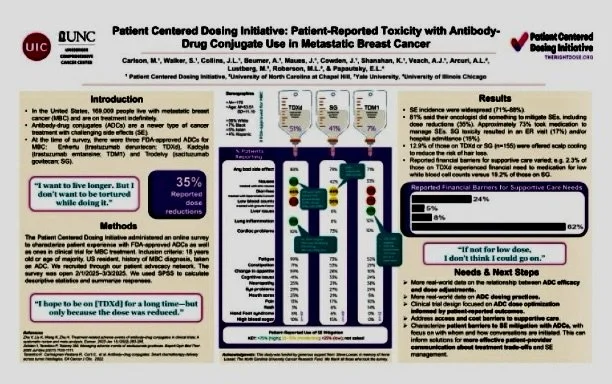
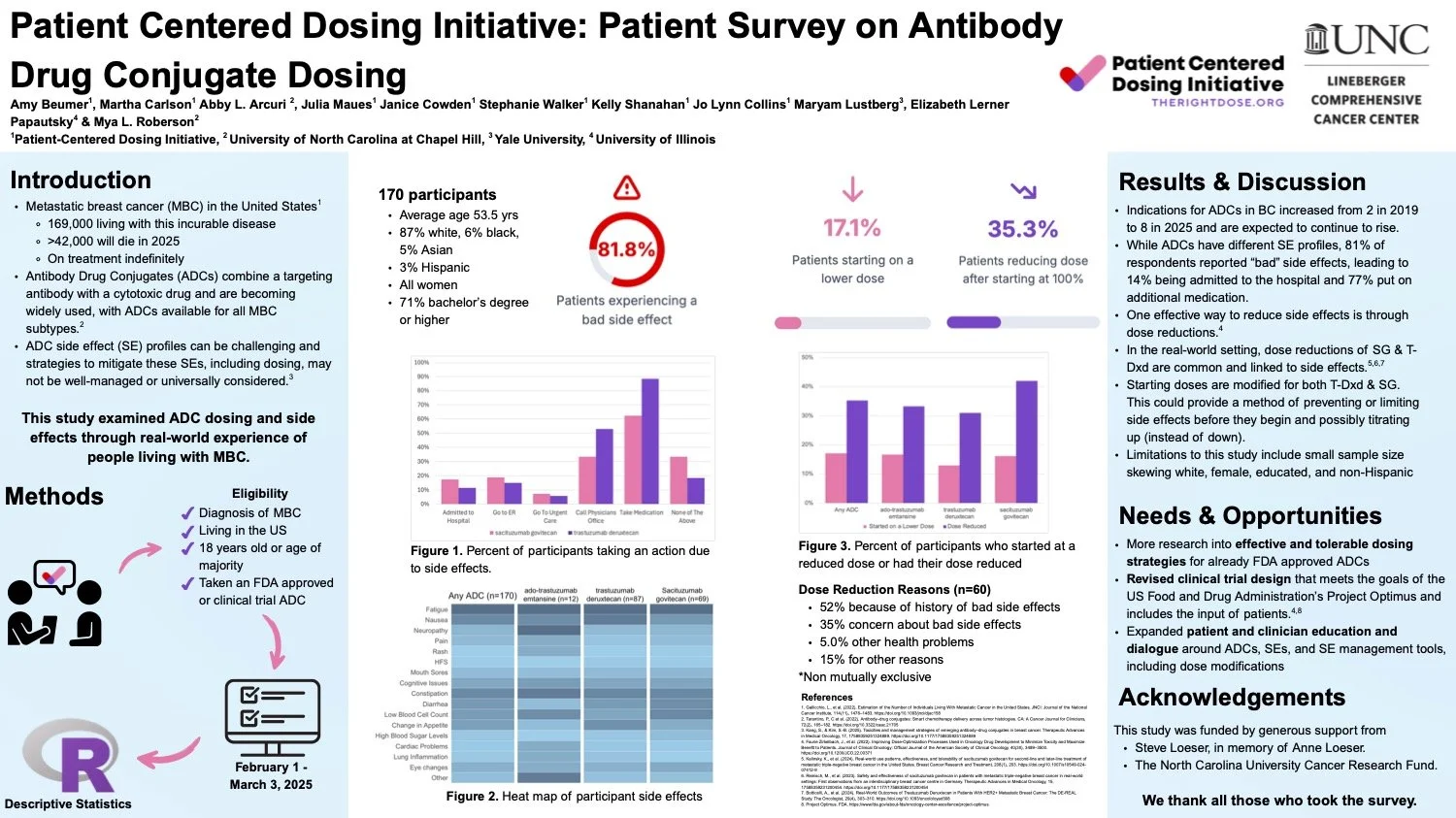
A study on antibody-drug conjugate (ADC) dosing experiences among patients with metastatic breast cancer (MBC) was published in the Journal of the Patient Experience.
Key Findings from the Survey
Sample Size: The study surveyed 170 individuals in the United States living with MBC who had received ADC treatment either through FDA-approved options or clinical trials.
Initial Dosing:
94.1% of respondents started treatment with the recommended dosing frequency.
82.9% started with the recommended standard dose.
Dose Modifications:
35.3% of participants reported experiencing dose reductions.
The main reasons for these reductions were actual or anticipated side effects that impacted quality of life.
Recruitment: Participants were reached through 21 closed MBC patient advocacy networks and Facebook communities, with assistance from the Patient Centered Dosing Initiative.
Impact: The ADC survey was published in the Journal of the Patient Experience. When shared with pharmaceutical companies, it sparked important conversations about prophylactic measures to prevent side effects—though some PCDI members note that companies are focusing more on supportive medications than on embracing lower starting doses.
Why It Matters: As new drug classes emerge, PCDI provides patient voice data in real time, showing that what happens in trials differs from what happens when real patients take these drugs at home.
2. The 2025 PCDI Survey
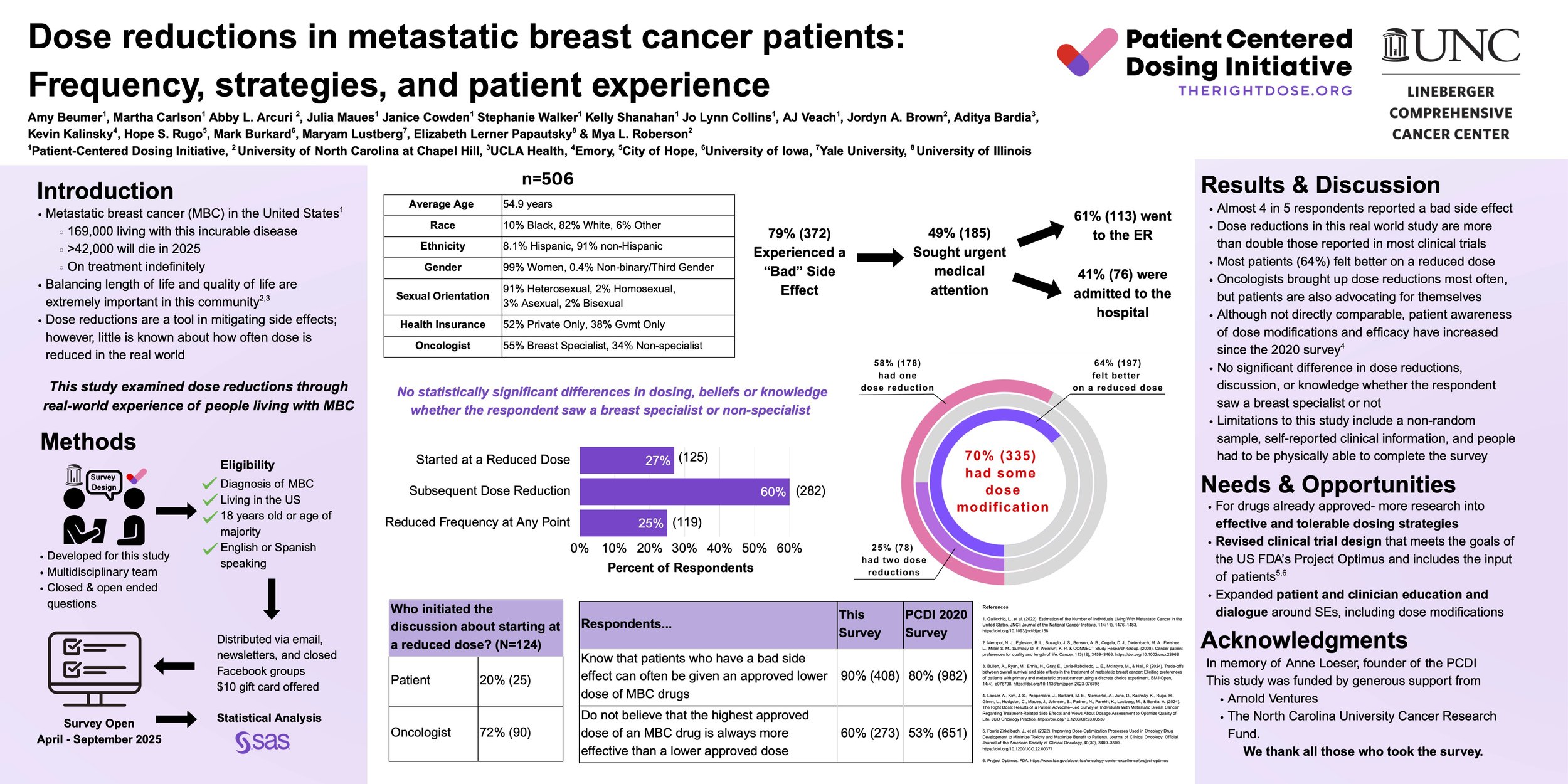
What It Is: A comprehensive update to PCDI's landmark 2020 survey. The original had over 1,000 respondents and was so impactful that Anne Loeser was invited to present findings at ASCO—an event that may have influenced the FDA's launch of Project Optimus.
• Expanding Scope: The updated survey captures more nuanced patient experiences and specifically looks at modern therapies, such as the usage and dosing of Antibody-Drug Conjugates (ADCs).
• Target Audience: The survey is strictly intended for individuals in the United States who have been diagnosed with metastatic breast cancer.
Core Context & Purpose
The initial PCDI research revealed that 86% of MBC patients experienced severe side effects, with 1 in 5 requiring hospital visits and over 40% missing scheduled treatments due to toxicity. Conversely, 97% of surveyed medical oncologists stated they are open to flexible dosing.
The initiative aims to build on these findings to shift oncology standard practices away from default "maximum tolerated doses" and toward collaborative, personalized dosing models based on an individual's unique health markers and quality-of-life goals.
Remember: You are the expert in living with your cancer. You're not alone, and you're not asking for too much.
What Changed Since 2020:
10 new drug indications in breast cancer (as of 2025)
New understanding of personalized dosing approaches
Advances in supportive care
Need to assess changes in patient knowledge and clinician practices
Key Findings:
Dose Modifications Are Common:
High proportion of patients with metastatic breast cancer experience some dose modification during treatment
Patients on later lines of therapy (4+) are more likely to have modifications
Side effects are the primary driver, but not the only reason
Toxicity's Real Impact (Qualitative Data):
86% of patients reported physical impacts: trouble exercising, walking stairs, doing household chores, self-care
17% reported cognitive impacts: difficulty concentrating, inability to work, professional setbacks. One patient shared: "Had to stop working due to cognitive decline."
Sleep disruption: "Kept awake by itching feeling in my upper arms"
Patients reported impacts across ALL aspects of life—and these barriers go unaddressed
Shared Decision-Making—Good News:
Overall, patients reported high levels of shared decision-making in their general care
Having a breast medical oncologist vs. generalist oncologist made surprisingly little difference
However: Patients with lower formal education reported slightly lower shared decision-making (though not drastically)
The gap: General care conversations are happening, but dosing-specific conversations are lagging
Diversity Remains a Challenge:
Respondents are still predominantly white, college-educated women
Age diversity improved significantly
Despite professional Spanish translation and targeted outreach, reaching non-English speakers and underrepresented populations remains difficult
This means we're missing the real-world experiences of Black, Latinx, and other communities with MBC
Supportive Care Barriers (Financial, Geographic, Systemic):
Patients struggle to afford medications like G-CSF (to boost white blood cell counts)
Many regions have no supportive care specialists; resources are geared toward inpatient settings
Young women face particular financial barriers
Patients already attend so many appointments; finding time for additional care is overwhelming
Not enough data: We don't know exactly where barriers occur—lack of offer? Financial? Burnout from too many appointments?
The Bigger Picture
What PCDI Wants Answered Next:
Why do we still start at maximum tolerated doses when data shows lower doses often work just as well?
What biomarkers could predict who will have severe side effects or respond to certain supportive care tools?
How can pharmaceutical companies share real-world dose-reduction efficacy data?
Can clinical trials be redesigned to study what actually matters to patients?
How do we reach and hear from patients who feel unheard by their care teams?
The Lasting Legacy: Anne Loeser died in October 2023, but her question "Does it have to be this way?"continues to drive PCDI's work. The team welcomes more patients to join. PCDI is small but mighty, powered by people living with metastatic breast cancer who know exactly what's at stake.
Action Items for Listeners
Get involved: Visit therightdose.org or email pcdi@therightdose.org
Learn more: Join the free webinar on Thursday, October 29th at 12:00 PM ET with PCDI, Project Life, and METAVIVOR
Registration link: https://us06web.zoom.us/meeting/register/uPc0yeLpRc2iMPATsVN7WA
Ask your doctor: Have a conversation about whether the dose you're on is the right dose for you. You have every right to ask about dose reductions, supportive care, and alternatives.
Resources
From this episode, you can link to two published articles about the PCDI survey on antibody-conjugate drug dosing and MBC at:
-
Victoria Goldberg 0:09
Could a cure for cancer be closer than you think? Welcome to Life from Stage 4, where MBC takes center stage as we talk to experts, share inspiring stories, break down signs, and shine the spotlight on what matters most. Because when it comes down to it, the spot, for us and by us, is all about us. Welcome to Life from Stage 4, the podcast where we get into the science and the lived experience of metastatic breast cancer. I'm Victoria Goldberg, and I'm living with metastatic triple positive breast cancer. So today's episode is a little personal for me. We're talking about HER2 positive breast cancer. And I have to say, if you had to pick one cancer type that has been completely transformed in the last 20 years, this is it. When I was diagnosed with my early stage cancer, HER2 positive was the subtype nobody wanted. Now it's the one with some of the most powerful treatments we have. A quick refresher for anyone new to this. HER2 is a protein that sits on the surface of breast cancer cells. When there is too much of it, the cancer tends to grow faster and more aggressively. But here is the flip side. Because HER2 is such a clear, visible target, we've been able to build drug after drug that goes straight after it. We're also going to spend real time on a subtype that's finally getting the attention it deserves. Triple Positive breast cancer. That's HER2 positive and estrogen receptor positive. For years, if you were triple positive, you just got folded in with everyone else who was HER2 positive. But we know now these cancers behave differently. The hormone pathway and the HER2 pathway actually talk to each other. And once you understand that, it changes how you think about treating it. You'll hear us reference a few landmark trials along the way. C LEOPATRA, which set the first line standard of care, the Destiny-Breast trials, which really opened a whole new era of HER2- targeted antibody drug therapies, and PATINA, which is asking the question a lot of us Triple Positive patients have been waiting on. How do we keep the disease controlled for the long haul? I could not have asked for better people to walk through this with me. Dr. Erika Hamilton is the Chief Development officer of late-phase research and heads the breast cancer research program at Sarah Canon Research Institute. She's one of the leading voices in HER2 research, and she's an old friend. And joining us, Dr. Sarah Premji, Assistant Director of Breast Cancer Research at Sarah Canon, and a medical oncologist with SCRI oncology partners in Nashville. And a little later in the episode, a dear friend and fellow member of our podcast team, Abigail Johnston, is going to join us. So, okay, let's get into it. And we're doing deep dive. So my first question, and I don't know who will take it, 25 years ago when I was diagnosed with early stage, HER2 positive was the worst possible subtype to get. Two years was about average of survival. And here we are now. How did we get here?
Dr. Premji 4:09
I can get started. And then if Dr. Hamilton wants to fill in the gaps, she has a lot of wisdom, I think, to offer here, but I'm happy to get things started. Just as you said, Victoria, we've come a long way. I think it's important to understand where we came from, and that helps us to really learn where we're going. And from every trial that's done, there's something that is to be learned from it, whether it's a positive or negative study. And it's how we continue building. It was the late 1990s, if I'm remembering correctly. Well before I was in practice.
Victoria Goldberg 4:40
You were rub it in. Why don't you?
Dr. Premji 4:45
So if I'm remembering correctly, it was the end of the 1990s. I think it's like 1998. Dr. Dennis Slamon's group showed that the addition of trastuzumab to chemotherapy had improved median progression-free survival for patients. And then I think what you may be referring to is C LEOPATRA in 2012, which was absolutely instrumental to now what has been standard of care really up until this point. And so that was testing pertuzumab with trastuzumab plus a taxane, which showed a 16 plus month improvement in overall survival with 37% of patients being alive at eight years. So really quite remarkable data.
Dr. Hamilton 5:28
Yeah, I completely agree. I think whenever we look at one individual trial, sometimes we're impressed by those results. But really, it's a stair step. When we add up all of these benefits over the past decades, we really can see where we've come from, whether it's the antibodies, whether it's the tyrosine kinase inhibitors. And now with antibody drug conjugates, that's really the latest development and really is revolutionized the way we treat. So looking at survival, not just in the metastatic setting, but now also looking at the cure rates, the percentage of patients that will be cured that get treatment in the neoadjuvant or adjuvant setting, even with quite advanced node positive disease, really is remarkable. We're not done. We're not happy with where we are, but where we've come from really is quite impressive. And so, like you said, now HER2 is not the dreaded type of breast cancer and really has quite good outcomes, very different than when we used to initially talk about HER2, where it really had a much more dismal prognosis.
Victoria Goldberg 6:44
And that spans more than two decades of breakthrough research. 1998, the story starts here. Trastuzumab, the first monoclonal antibody designed to target HER2, was approved. Before this, HER2-positive breast cancer was devastating. Two years' survival was roughly 50%. Trastuzumab changed that. When combined with chemotherapy, it extended survival. Suddenly, HER2 positive went from a death sentence to a disease we could fight. 2012, this is when CLEOPATRA was published, the landmark trial that changed first-line treatment. It tested the combination of Trastuzumab, Pertuzumab and a taxane chemotherapy. The results were extraordinary. Over 16 months of additional overall survival. 37% of patients were alive at eight years. That's remarkable. For many of us, including me, CLEOPATRA became the gold standard. It's what I was treated on. From 2016 to 2020, while CLEOPATRA held strong as the backbone, researchers were working on something new: antibody drug conjugates. These were a different approach. The antibody carries chemotherapy directly to the cancer cell. Destiny-Breast-03 tested Enhertu in the second line, the results were stunning. Both progression-free and overall survival improved dramatically compared to standard treatment. From 2021 to 2022, Destiny Breast09 asked, What if we move the drug to first line? Could we replace the taxane-based CLEOPATRA regimen? The trial showed Trustuzumab Deruxtacan (Enhertu) with Pertuzumab improved progression free survival significantly compared to the classic CLEOPATRA combination. Suddenly, we had choices. Suddenly, the field was evolving in real time. 2023-2024. New trials like PATINA and HER2 CLIMB-05 are further refining this approach. For triple positive patients, PATINA showed that adding a CDK4/6 inhibitor with endocrine therapy beats indefinite chemotherapy. HER2CLIMB-05 show Tucatinib in the maintenance setting extends disease control. The point is this: every single milestone, 1998-2012, Destiny, PATINA, HER2 CLIMB, represents years of research and thousands of patients. And it means that if you're diagnosed with HER2-positive breast cancer today, your options are vastly different from mine 20 years ago. The field isn't static, it's rapidly evolving. And that's why staying informed matters so much. You just mentioned cure. So I was in Lisbon at the ABC8 conference, Advanced Breast Cancer Global Conference, and two people, Dr. Eric Winer and Dr. Sandra Swain, said the same thing. They said that they think we're curing people on the classic CLEOPATRA regimen. Do you agree with that? Do you think that there are some people who have been cured just by the CLEOPATRA?
Dr. Premji 10:19
Yeah, I've seen it in clinic. I've seen that we've had some patients for whom we've been able to utilize this regimen and they have no evidence of disease, and it's years and years and years, and that's why there's trials now testing the ability to stop these therapies and watch very closely. So I think that's incredible that we've gotten to this point.
Victoria Goldberg 10:39
Just hearing the word cure from the medical community for metastatic stages is quite something. But I have a question for you actually that is not on my list of 17 questions, but I just thought of that. We're talking about the cure. What about the word chronic? How do you feel about the word chronic for people living with metastatic disease?
Dr. Hamilton 11:05
Yeah, in general, whether we talk about cure, whether we talk about chronic, we have to be really careful about our words because any word probably isn't going to encompass everybody's experience. And initially, when somebody gets diagnosed, I don't even talk about the option of cure because the reality is that's not going to be an option for most of the patients we see. And it's really a very small subset of patients that are exceptional responders. And so I don't think it's fair to even throw that out there or promise that as something that might happen until you really see the response and see how well somebody is doing to put that on the table. You know, chronic, I think the reason that word comes up now is because our survival is so long that we're starting to talk about that metastatic cancer is something you have to live with, that we're still having to treat other chronic medical conditions like hypertension and diabetes. And we can't put all those other things on the back burner and ignore them because our patients are living longer and other things can kill them before their cancer does. But the reality is for a lot of our patients with metastatic disease, cancer isn't necessarily chronic and it is what takes their life. So I think we have to be careful. It is chronic in the way that our average survival is in excess of five years now. But we also have to be clear with patients that it is likely going to shorten their life and make sure that they have realistic expectations too. And so whenever we boil a very complicated situation down into one adjective, some of those nuances get left out.
Victoria Goldberg 12:48
Yeah. How do you feel about this, Sarah?
Dr. Premji 12:50
I think it is important to set the stage with patients early on. And I also don't envy the patient experience. I think it's very difficult for patients. They are getting information from everywhere and every direction. And so it's really hard to try to synthesize this and understand as a singular individual patient, where do I fit into this and what is actually realistic for me? And just like Dr. Hamilton said, it's very specific to the patient sitting right in front of you. Their tumor characteristics, their co-morbidities, what has happened to this point. There's still so much left to uncover to figure out who is in that bucket versus who needs some additional therapies.
Victoria Goldberg 13:29
Yeah. I asked you earlier about the CLEOPATRA results and long-term survival data seem very exciting even now. And we're talking about more things that are being added to the CLEOPATRA protocol. But looking back at the original, the classic standard of care, CLEOPATRA, a number of people are doing very well. Do we know what the characteristics of that group are? Do we have any idea who those people are and why they're doing better than the others?
Dr. Premji 14:01
There are some things that are important to note. So strong HER2 positivity. So immunohistochemistry, when you're looking under the microscope at the staining of the tumor, it's strongly amplified by HER2. That's a predictor. And then also there are HER2-positive tumors that also are driven by hormones, too. So hormone-positive, HER2 positive. Those tumors we believe exhibit crosstalk between hormones and HER2. And so those patients may not have as robust of a response, which I'm sure we'll talk about that in a little bit as we get into patina.
Victoria Goldberg 14:46
Let's pause here. Because this word, crosstalk, is really important. And it's actually the core reason triple positive disease behaves so differently. Most of the time, when we talk about HER2-positive breast cancer, the tumor is driven primarily by the HER2 pathway. That's the main engine. But when a tumor is also hormone receptor positive, when it has estrogen receptors on it, we have two different engines running at the same time. And here is where it gets interesting. These two pathways don't operate in isolation. The hormone pathway and the HER2 pathway actually communicate with each other. They influence how each other works. That's the crosstalk. Think of it like two signaling systems in the cell. Estrogen binds to its receptor and signaling to grow, divide, survive. HER2 does the same thing. But they're not just sending independent messages, they're amplifying each other. The presence of one pathway can make the other pathway work harder or more effectively. It's synergy. That means if you only target HER2, you're not silencing the hormone engine completely. The cancer cell still has the estrogen signaling telling it to grow. Similarly, if you only use hormone therapy, the HER2 pathway is still pushing the cell forward. That's why triple positive tumors historically did worse than HER2-positive hormone-negative tumors. When we treated them the same way, we were only hitting one of the two pedals. We needed a different approach, one that addresses both pathways simultaneously. That's what Patina, a newer strategist, is starting to do. And that's why, as a triple positive patient myself, this distinction matters so much to me. Let's get back to Sarah's insight on why some patients respond incredibly well to the CLEOPATRA protocol.
Dr. Premji 16:49
But to that point, I think that there are certain characteristics, maybe strongly HER2 amplified, does not express hormones or grow their tumor via hormones that we think can do better than those that are HER2 IHC2 plus, and then they have fish positivity or some other way for which HER2 is growing their tumor.
Victoria Goldberg 17:09
Do you feel that the de novo group could do better in this setting?
Dr. Premji 17:15
Yeah, so we know that the folks that have localized HER2-positive breast cancer and then get therapies in a localized setting and then develop metastatic setting, there's something that's resistant about their tumor. And more than likely they had been exposed to some sort of cytotoxic therapy, plus the monoclonal antibody, plus minus the second one. And so to develop metastatic disease, there's something about those tumors that perhaps you could argue is more resistant than those exactly as you're alluding to that are de novo metastatic.
Victoria Goldberg 17:46
All right, before I go any further, there are four of us now. And my friend Abigail Johnston has joined us. I don't know if you guys know Abigail. Good morning. She's here with us, and I'm very happy to see her. So we are talking now about the first line treatment. So for many, many years, the first line treatment was the Cleopatra protocol. It did very well for people. Now it's antibody drug conjugate. And I'm wondering, Sarah, maybe we should remind our listeners what an antibody drug conjugate is.
Speaker 18:22
Yeah, absolutely. So an antibody drug conjugate, I like to call it when I'm talking about it with my patients. I like to call it fancy chemotherapy because at the end of the day, it still is chemotherapy, but it's linked in a very specific way. So just as you mentioned, so it's a monoclonal antibody that's linked to a target. It's linked in a very specific way. It's linked to the HER2. So that's the target. And then when we talk about the payload, that is where the chemotherapy comes in. And various antibody drug conjugates are now being developed. Some are out on the market that have various targets and various payloads. And then the payload ratio may be different in every different antibody drug conjugate. So as we mentioned in HER2 or TDXD, which is what we're talking about here specifically, this is an antibody drug conjugate in which you have a HER2 target with a chemotherapy payload, a topoisomerase 1 payload, which is still chemotherapy, that then links up with the target. It basically releases the chemotherapy inside the cell to kill the cell, and by the process of what we call bystander effect, leaks the chemotherapy in the surrounding cells and then kills those cells. Patients still will get the side effects of chemotherapy. So hair loss, the blood counts going down, nausea, vomiting. They may get it to less of a degree because it's more targeted, but that certainly is the way that lots of different cancers are studying therapies via antibody drug conjugates.
Victoria Goldberg 20:05
So Sarah explained how the antibody finds the HER2 target and delivers the chemo payload inside the cancer cell. But there is something really important that happens next: the bystander effect. When that chemotherapy releases inside the cancer cell, some of it leaks out into the surrounding cells, even cells that might not have HER2 on them. That's actually helpful because it kills more cancer cells. But it also explains why the side effects are so strong. Here is the key difference. Traditional chemotherapy moves through your body pretty quickly. Your liver and kidneys break it down, and it's mostly gone within a few days. But an ADC is the big, bulky molecule, and your body takes much longer to process it. We call that the half-life, the time it takes for your body to clear away half of the drug. Think of it like this. If you take a dose of regular chemo, half of it is gone from your system in a day or two. But with an ADC, it might take a week or more for half of it to clear. That means the drug is still circulating in your bloodstream, still in your cells for much longer. That's actually great for killing cancer. More time for the drug to do its job. But it means the side effects also last longer. The bystander effect is still happening in your gut cells, still affecting your hair follicles, still causing nausea, not just for a few days, but for a week or more after you get the treatment. And because it's such a big molecule, some people's bodies hold on to it even longer than others. Their liver or kidneys process it slower. That's why some patients need those reductions, not because they're weak, but because their body is accumulating more of the drug. Getting a higher concentration and experiencing more side effects. Before we begin, let's establish some key terms you're going to hear from Dr. Hamilton in a second. THP is a shorthand for the classic CLEOPATRA regimen. Trastuzumab or Herceptin, Pertuzumab or Perjeta, and a taxane, which is chemotherapy. It's the backbone that transformed HER2 positive treatment for years. Now, TDX-D stands for TrastuzumabDeruxtican, and that's the game changer we're about to discuss. Its brand name is Enhertu. Keep those definitions in mind as we walk through the Destiny trials. Dr. Erika Hamilton, let's talk about Destiny Breast. There are so many of them. Let's talk about that.
Dr. Hamilton 22:54
Yeah, so there are a lot of Destiny Breast studies. It gets confusing. Destiny Breast 03, I think, is probably our original trial that really improved both progression-free survival and overall survival dramatically for TrastuzumabDeruxtican in the second line and really cemented in Enhertu as a treatment option there. DBO9 looked at bringing this up in the first line where CLEOPATRA, the THP regimen, had been. And it was a three-arm trial. So a little bit different than some of the other trials we typically see. And it had a TrastuzumabDeruxtican with pertuzumab, a TrastuzumabDeruxtican alone, or the classic THP CLEOPATRA regimen. And really, so far, we've only seen the results of two of those arms, the TrastuzumabDeruxtican, pertuzumab arm, and the CLEOPATRA arm. We still haven't seen the results of the TDXD alone arm. And what we saw was TrastuzumabDeruxtican with pertuzumab dramatically improved progression-free survival. Really impressive results. We don't know how it's going to be with TrastuzumabDeruxtican by itself. Now, honestly, it's created a lot of conversation because patients are doing so well for so long that it's kind of raised the question of is it appropriate to continue a cytotoxic agent for that long? And especially because with the CLEOPATRA regimen, our practice pattern has really been six to eight cycles of induction chemotherapy with that taxane and then stopping the taxane, continuing your trastuzumab and your pertuzumab, we call it HP typically, informally. And then if patients have ER positivity, we typically add endocrine therapy. And then we can talk about some other more recent maintenance trials that are coming and are here. But that can be really well tolerated for patients when the chemotherapy drops out and we're in this maintenance strategy. And Destiny Breast-09 didn't account for a maintenance strategy. It really was tTrastuzumabDeruxtican, pertuzumab forever. And so when you're thinking, gosh, these patients could be on two, three, maybe four years of a cytotoxic, it has us saying, okay, well, could we extrapolate the maintenance data to Destiny Breast09, even though it wasn't part of the trial? Really, a lot of us asking in this data free zone, are we going to do this even though we don't have data for this? The other interesting thing in Destiny Breast 09 was we also saw double the rate of complete responses compared to CLEOPATRA. And getting back to your initial question about the so-called cure, I think those are really the patients that we think might have extraordinary outcomes. And so, at least for me, I wouldn't want to come in with TDX-D and Pertuzumab and just say stop it after six cycles when somebody's had a good response. If they haven't gotten to the deepest response they could, if they could potentially get to a complete response and not let them get to that deepest response they could, because I'm not sure that I'd be doing my patient any favors there. And so a lot of us are starting to talk about this maybe treat to a maximal response before we would think about then going into a maintenance regimen.
Victoria Goldberg 26:32
You know, I've talked about it at nauseum. I was treated on the CLEOPATRA Protocol, but differently than most people. So my induction phase lasted five years, not six treatments. And I don't know whether it's because of that or whether I was just lucky. And when I was first diagnosed, I was very advanced. Look at me, I'm 12 years out and I'm still on the first line of treatment. So I agree with you. I think this is the time for us to look into maybe taking it a step further and do exactly what you said. There are some trials out there, the SAPPHO trial and the HERizon Breast trial, that are doing exactly that. I just mentioned two interesting and groundbreaking trials, SAPPHO and HERizon Breast. I think it's important to talk about them, both the curative intent trials for the newly diagnosed HER2+ MBC patients. Let's start with SAPPHO. It's a phase two study out of Dana Farber, and here is what makes it different. It's testing a planned sequence of HER2 targeted therapies for de novo metastatic disease. The idea is you start with taxane, Herceptin and Perjeta , then you move to TDXD, followed by T ucatinib with TDM1. And instead of waiting for the cancer to progress before you switch, you're heating it with multiple non-cross-resistant therapies one after another. The hope is that this approach deepens your response and potentially, and this is the exciting part, allows some patients to stop treatments while still maintaining control. That's the kind of thing we're talking about. HERizon Breast is another phase two study, but it's using something really clever - ctDNA monitoring. They're following circulating tumor DNA to guide when to switch treatment. So it's personalized sequencing based on how your cancer is actually responding. And here is what I really like about it. They're including CNS prophylaxis, which means they're trying to prevent the cancer from spreading to the brain and spinal cord. That's something we don't always talk about, but it is so important in HER2-positive disease. Both of these trials are open to adults 18 and over with metastatic HER2-positive breast cancer. And honestly, they represent exactly the kind of thinking we need. Moving beyond one size fits all and really personalizing how we treat this disease. So the side effects are pretty tough on an antibody drug conjugator, and especially this one. There is an Enhertu group on Facebook, and we're trying to get them to come and talk to us about their side effects and their experience. But we all know that it's not easy. And it seems that it's a little different than traditional chemo side effects. So in the traditional chemo side effect profile, you get your chemo, and then for the first week you feel awful. And then if you're lucky enough to get it once every three weeks, the next two weeks are pretty good. But what I've been hearing that on Enhertu and other antibody drug conjugates, this is not the same profile. People have nausea in the second week, the third week. Actually, Abigail was on Enhertu, so Abigail knows all about it. Do we know why this is so why is this so different when people are on antibody drug conjugates?
Dr. Premji 30:22
So I'll start and then I'll ask Dr. Hamilton to jump in too, but I think this is a big bulky molecule. It has a much longer, what we call half-life. It hangs around in the system for a lot longer than chemotherapy. Chemotherapy is quite predictable at this point, at least the traditional chemotherapies. We know how they work. We know when they reach their peak and then when they come off and they're dosed in this way. Enhertu, as one of the examples of antibody drug conjugates, it hangs around the system for a long time. It's the same reason why when we talk about, for example, hair loss that can happen, you know, with traditional chemotherapy, we know that cold capping, as an example of a way to try to preserve hair loss, doesn't work as well. Why is that? It's because the antibody drug conjugate will hang out in the system for a lot longer period of time. We have differences in the pharmacokinetics and pharmacodynamics of these various molecules.
Victoria Goldberg 31:16
I will ask you another question. So it seems that some people, and I think Abigail was one of those, get a reduced dose. Why do we always start with the high dose? If we know that the reduced dose is efficacious, why not start with the reduced dose when we have people starting on this regimen?
Dr. Hamilton 31:37
Yeah, so that's a complicated question. We've had some studies that show that for patients that need a reduced dose, that the reduced dose is equally likely to work. A lot of that data was around CDK4/6 inhibitors most recently. But those are people that need a reduced dose for a reason. They had a lot of side effects. They had excessive fatigue, they had excessive neutropenia, they had excessive diarrhea from within the cyclib, et cetera. It doesn't apply to just starting a reduced dose out of the gate. And it's kind of complicated to think about. But essentially, we dose all the drugs the same. It's either a flat dose if it's oral or it's milligrams per kilogram. And that doesn't account for different people having a little bit of a different exposure. So different people will process drugs slightly different. And sometimes we think that people that have a little bit of a higher exposure to the drug are people that are more likely to have more side effects. And so by reducing their dose, is actually taking them down to more of a dose that someone else is actually getting if you leave their dose where it is. And so, as you can imagine, by just dropping everyone's dose, you might be dropping some people below where they really need to be. And so that's why we really tend to start where the clinical trial showed us the best dose is. But you bring up a good point that it's not one size fits all. And so that's really where this conversation between a provider and the patient is about how they're doing on that drug, because we know that dose reductions are there in the clinical trials where the drug shows promise. There's a good percentage of patients that ultimately do need dose reductions. And so if that makes a drug more tolerable for patients, allows them to be on it longer, allows them to have a better quality of life, then that's what we want to do. And honestly, I think sometimes dose reductions aren't talked about enough as a way to tolerate a drug better. Sometimes people just stop a drug without ever even trying a dose reduction because they don't know that a dose reduction is an option. And so always a better idea to try a dose reduction than to just stop a drug because of side effects, because sometimes a dose reduction can make a big difference in the side effects and how somebody experiences a drug.
Victoria Goldberg 34:11
We've talked about nausea, fatigue, hair loss, the side effects most people expect from chemotherapy. But there is one side effect from an HER2 and other antibody drug conjugates that deserves much more attention than it usually gets: interstitial lung disease or ILD. ILD isn't just a cough, it's not pneumonia, it's inflammation and scarring in the lung tissue itself. Specifically, in the tiny air sacs where oxygen transfers into your bloodstream. When those air sacs become inflamed and scarred, they thicken. Oxygen can't cross as easily. Your lungs stiffen, you start to feel short of breath. In mild cases, you might notice it during exercise. You can climb the stairs like you used to, or you get winded walking. In more severe cases, it becomes disabling. You're struggling to breathe at rest. Why is ILD so dangerous? Because if it progresses, it can be life-threatening. And I like nausea or fatigue, which improve after you stop the drug, ILD can become permanent. The scarring doesn't always fully reverse. That's why if ILD reaches a certain grade, if it becomes symptomatic, doctors have to stop Enhertu immediately, even if the drug is working beautifully against your cancer. Even if you want to keep going. ILD happened in the clinical trials. It's rare. Not everyone gets it, but it happened enough that we need to take it seriously. That doesn't mean Enhertu isn't worth it. For many people, it's transformative. But you need to know this risk going in. You need to understand what to watch for, why your doctor is scanning you more frequently, and how to communicate with your team if something feels off. That's exactly what Abigail is about to ask.
Abigail Johnston 36:14
Could I ask a question about interstitial lung disease? So one of the things that I did prior to starting and her too was to go get a baseline pulmonary function test because I had had pneumonitis when I took Ibrands a few years ago. And that gave my doctors a baseline. I also had a pulmonologist that followed my scans, watching for any warning signs since ILD was so significant during the trial. Is that a reasonable way to manage one's risks for ILD? Or how are you all having your patients do that?
Dr. Hamilton 36:47
Yeah, it's interesting. Pulmonary function tests ( PFTs), it was kind of should we do that? Could we do chest x-rays? Could we do other ways of predicting who is at higher risk? PFTs haven't borne out as a way to really screen for ILD. So that isn't currently recommended. I think your case was a little bit different because you're somebody that had already had a pneumonitis, ILD. So really, right now, the recommendation just centers around high-resolution CTs. This is not something we can see on a simple chest x-ray like a pneumonia. These are more subtle changes. And we really want to be able to find these ILD, pneumonitis events before they become clinically significant. Because once something's grade two or it has any symptoms, cough, shortness of breath, lower oxygen, that's a case with Enhertu, where we're not supposed to rechallenge. You're not supposed to go back on the drug. You have to stop it. And so what that means for Enhertu in my practice, is that I'm keeping my scanning interval pretty short. Because if somebody's gonna get ILD, I want to see it on the scan when they're asymptomatic. I can stop the drug, I can treat them with steroids, I can get rid of it, and I can get them back on the drug because this is a drug that can benefit a lot of patients for quite a long time. And so, in some ways, sad when somebody gets ILD and they have to stop it and it's still working for their cancer. And a lot of times it's really sad for the patients because they feel like that drug's been taken away from them and they don't want to stop it. And you're like, no, no, no, we really have to for safety. Different institutions have different protocols. In the clinical trial, scans were done every six weeks. That's a challenge in the real world because insurance companies aren't gonna pay for scans every six weeks. It's a lot of radiation. We typically can get scans paid for every two months or longer than that. And so I typically continue my scans every nine weeks. So right over that two-month threshold, I don't space it out. And a lot of times for a drug that somebody's gonna be on potentially for a very long time, we get a little bit more lax with that scanning interval. Patients don't like going to the scans all the time. But for trust who's mabdroxtocan, I do keep it in every nine weeks just so we can find that ILD early if it's gonna happen, so we can get the patient back on the drug and they don't have to stop it. But it's a fantastic question. We've also looked at a lot of risk factors. Is smoking a risk factor? Is having pulmonary mets a risk factor? And it's really hard to tease out who's gonna have it and who's not gonna have it. We know that it's a little bit more likely to happen in the first year, but there are patients that get it outside of that first year. In fact, my only case, knock on wood, of grade three ILD happened to a patient that was outside of her first year of trust who's a mab directocan. So despite all of that data, I'm not a big fan of, oh, really, outside of the first year, we don't need to worry about it as much. And we can space out the scans because that in my experience hasn't been the case, even though the data I know does show that the majority of the cases do happen there.
Abigail Johnston 39:58
But it would be reasonable if you've had pneumonitis or ILD on a previous line to then watch more closely on trust cheese and med direct. Absolutely. Okay. Because that was the question when I started a few years ago. There wasn't quite enough data to know is it really something that would happen again? So I did find that working with a pulmonologist who had some specialty in ILD was really productive for me and took that pressure off of my medical oncologist also. Absolutely.
Dr. Hamilton 40:29
And you know, right now, having ILD with one antibody drug conjugate a lot of times is a contraindication to trying another antibody drug conjugate. It doesn't extend across different classes of drugs. So we don't think that necessarily that kind of crosses over. But honestly, we're learning that a lot of our drugs can cause ILD, just albeit at a little bit lower rates than we see with trustuzumab drugs to can.
Victoria Goldberg 40:55
All right, let me ask you this. We're talking about ILD. So the Destiny-Breast-09 trial, the Enhertu arm had 13 deaths related to treatment. And ILD is one of the reasons. When you have a new patient and you are thinking of starting this patient on this protocol, what information do you share with them? What information should you present to your patients when we know that there are some sobering facts about these drugs?
Dr. Premji 41:29
Yeah, I can start. I talk about all of it. I talk about the efficacy, the progression-free survival data, I talk about various side effects, among them being a potential risk of ILD. And then I talk about what we look for. And then to Dr. Hamilton's point, I emphasize the reason as to why we get scans more frequently than, say, other types of therapies and the reason why we do that and how we can intervene in that way. So I do think laying all of that information out on the table, it does become difficult in the winter months. There are various things that can cause shortness of breath. But when I have a patient who's on in her two, both the patient and I have increased vigilance while you know there's a healthy level of skepticism and hope that it's not in HER2 that's causing any respiratory issues. And when you don't know, it's important to keep that open line of communication between the provider and the patient so that they are able to then reach out to you and tell you. And then just like Dr. Hamilton mentioned, if you catch it early and you give steroids and you can eliminate it on scans, we now have a lot of data that you can safely rechallenge. Um, and so I talk about that with patients too. And this is why we get the scans so frequently, and this is also why I really need you to reach out to me and let me know how you're feeling or if anything is off. You may just be in yoga and you can't take as deep of a breath as you usually do. Like that's still something to tell your provider. That's something that's different.
Dr. Hamilton 42:55
I think it's good for our patients to be educated because something like a cough, people often chalk it up to a respiratory virus. I mean, we have COVID, we have flu, we have colds, and somebody might go to a walk-in clinic or go to their primary care doctor, and it might not be recognized. Oh, this might be ILD. And so I think this is one of those side effects that they need to be aware of of I want to hear about it. I don't want you just going uh somewhere else. And so when we moved from Enhertu, when we participated in the clinical trials to the real world, it was one of those things that I was a little bit worried about. How is it gonna play out when it wasn't just at clinical trial centers? And so I just make sure that I really educate my patients that shortness of breath, cough, a change in exertion and you being able to carry laundry up the stairs, kind of thing, that stuff that I want to hear about. You need to know that you know, your drug has a lung side effect. So make sure anybody you interact with knows about that. I think always great to empower people to understand that. So they're not reliant on every provider. That they interact with knowing about their oncology drugs, which we know doesn't happen.
Victoria Goldberg 44:05
And what do you do about the other side effects that are very common with Enhertu, like vomiting and nausea? They seem to affect almost everyone. There are some people who are doing really well on this drug and have no side effects, but for the most part, right, there are side effects. So how do you present that to your patients before they start? Do you even talk about that?
Dr. Premji 44:29
Yeah, absolutely, absolutely. Because we know that if patients are struggling with nausea, they're probably not going to be eating. And then we worry about their nutrition. That also significantly affects their quality of life. So I do think that talking about nausea up front is really important. And we premedicate when we give our drug, but it's not just that. As you just said, some patients continue to have nausea throughout their cycle. So what medications can you provide? We're actually finding that in addition to ondansetron (Zofran) we use and Compazine that we use, Olanzapine is a good drug to use in a very specific way. Sometimes we start at a lower dose, like 2.5, and then we can bring it up to five milligrams. It can go higher too. But at least starting there, and then we have other antiemetics that we can use. There's a difference between taking the medication when you feel nausea, and then, as I mentioned, prophylactically. So acting ahead and taking it scheduled. And I think every patient is very different.
Victoria Goldberg 45:25
There is one side effect that everyone complains about when it comes to Enhertu, is cancer-related fatigue. Every single person I've ever spoken to, and Abigail, you've had that too. So how do you deal with that?
Dr. Hamilton 45:41
Yeah, I think fatigue is one of those tougher ones because it's one of those things that's hard to quantify if you're not the person living with it. Nausea, is it are you throwing up? Is it affecting what you're eating? It's easier for us to get a grasp on it and it's easier medication-wise to treat. I think fatigue is this nebulous thing that's harder to quantify. Ritalin (methylphenidate), now has an indication for cancer-associated fatigue. And I find that a lot of my women do really well on Ritalin. Sometimes there's a what you want to give me what? But I definitely talk to patients about that. Most patients do very well on it once they get over the kind of, well, I don't have problems concentrating. But a lot of times a pill in the morning, a pill at lunchtime just gives you that extra little bit of energy to get through the day. You don't take anything at night when you would be thinking about going to bed shortly thereafter. But sometimes that gives people that little extra boost, motivation to do the things that they want to do. In my experience, I find that the older the woman, the particularly better they do with it, ironically. It helps my 30-year-olds a little less, but like my 50, 60, 70-year-olds do really well on a low dose of Ritalin. So that's a trick that I've learned. And then I want to echo Dr. Premji's trick about Olanzapine. We definitely did not invent this in the breast oncology literature. We stole this from the GI oncologist with Olanzapine, but it's a drug that works really well. It's also a CNS medicine. We stole it from psych. We only take it at night and it works all the next day to prevent nausea. But a lot of patients really like it because it's not a pill that they're having to take during the day. They take it at night and it works all the next day. And it can be really effective for any cases of refractory nausea. So we're getting a little bit smarter with our supportive care.
Dr. Premji 47:39
And then also for the fatigue, too. I run into lots of patients who have other undiagnosed issues. They maybe deplete in their B12 if they're vegetarian, for example, or perhaps beyond the anemia that can be caused by Enhertu, they had some other form of iron deficiency anemia and they need just repletion of their iron, or they're low on their vitamin D, depending on where you live. You're not spending enough time in the sun. So I think checking all of the other vitamin levels that have shown that if you replete, that you can improve fatigue. There are some trials out there looking at American ginseng as well for fatigue. So that's something that we can talk about with patients.
Victoria Goldberg 48:18
Well, thank you. This was fascinating. I love it. But we have 15 minutes and we need to talk about my favorite topic: triple positive metastatic breast cancer. For years, people like me, who are highly ER-positive and HER2 positive, were dumped together with the HER2 positive, ER negative. And our crosstalk was never mentioned. And if we were lucky, we would have gotten some endocrine treatment after the CLEOPATRA protocol. Things have changed, haven't they? Is now triple positive known as a different subtype? Is that its own subtype now?
Dr. Hamilton 49:01
I would say that things are changing. I think we're probably being too optimistic to say that they've already changed. If we look at some of the trial data,
Victoria Goldberg 49:10
don't rain on my parade. I know.
Dr. Hamilton 49:13
We're working on it, Victoria. Despite the fact that endocrine therapy is allowed, when you look at the real world data, even HER2CLIMB-05, etc., or when we look at the data, not everybody's getting that endocrine therapy in the maintenance setting that even could be. So I still think it's under recognized. Probably what is still under-recognized is even just some strategies of therapy and other combinations, PI3 kinase combinations. We're looking at more of those trials. It's probably not all ER and HER2 positive, but I think there's a subset that's really more of an endocrine-driven breast cancer and less of a HER2 breast cancer. But you're right, we really didn't think about it as much as we should have. Probably the trial that's most pertinent to talk about here is PATINA. And so patina took that population of patients from the CLEOPATRA trial that were progression-free. They dropped out their taxane, and everyone had ear-positive breast cancer. And they asked the question of would adding palbociclib (Ibrance) when they got their endocrine therapy and were continuing the HP benefit. And I think honestly, we were all blown away by the magnitude of benefit of adding palbociclib . And personally, it was a little bit of a resurrection for palbociclib when palbociclib's data was looking less fancy and shiny compared to ribo and abema. Good data for a CDK4/6 inhibitor there as well. So, really a benefit of over a year of additional PFS of adding palbocyclib. So I think very exciting. Most patients would definitely pick trading adding endocrine therapy with a CDK compared to indefinite taxane. Most of the time, our side effects compare quite favorably there. And I think it's really renewed more excitement around endocrine therapy and endocrine pathways for these patients that are triple positive. So I would say we are changing, but we're not done with our work there, Victoria.
Victoria Goldberg 51:14
All right. I'll be watching out for you guys. So we were talking about different pathways. So PI3K pathway. About 30%, I think. Is that true? Of HER2 positive patients have that mutation. ESR1 mutation also is not uncommon. Is there anything that you think you'll be doing or the science will be doing for people with ER-positive, HER2-positive kids?
Dr. Premji 51:41
I think as of right now, there are trials that are looking at this. But as of right now, and I'm sure we'll get into this quickly here at the end, but how do you sort out those that we recommend still sticking with CLEOPATRA, still receiving THP, versus those for whom we recommend to receive TDXD plus pertuzumab in the first line, metastatic HER2 positive setting? And I think that at this point, PIK3CA mutation may be one of those for which we may favor the use of TDXD plus pertuzumab for those, because as you were bringing up and alluding, ER-positive or hormone-positive HER2-positive metastatic breast cancer has been thought to have a slightly worse prognosis than traditional HER2-positive breast cancer. And why is that? And that could be in some way because there is that crosstalk, and traditionally we haven't been addressing the hormone-positive component of that. And then along the estrogen receptor signaling pathway that can occur, PIK3CA mutations can occur. And so how do we get around that? As of right now, we think that maybe those patients that are PIK3CA mutated maybe should consider getting TDXD plus pertuzumab potentially. But like Dr. Hamilton said, there are trials that are looking at this specifically. Do we use PI3K inhibitors? How else can we integrate our therapies to try to best address this population? I think that we're further subdividing as we go along to try to individualize our therapies.
Dr. Hamilton 53:04
I guess one thing I'll add is talk about tolerability problems. That's really been the Achilles heel of the PI3 kinase inhibitors. Alpelisib and inavolisib, certainly efficacious agents, tough in terms of hyperglycemia, in terms of rash, in terms of diarrhea. We made a little bit of benefit with Xeloda, got rid of the hyperglycemia, but we still have rash and diarrhea with that compound. I'll maybe just give a teaser. There are more selective compounds in clinical development right now. We're working with the drug that is in the public domain because it's enrolling now. So I think I can at least say something about it that's actually not an inhibitor. It's RAS-PI3K breaker. So it works in a very different way. And not only are they looking at ER-positive breast cancer, but they're also looking at HER2. This is a compound that I'm pretty excited about. It's still in phase one or early development, but not being a traditional inhibitor, we shouldn't have those side effects of the rash, the diarrhea, the hyperglycemia. So I'm hopeful that we can get a drug that really affects that pathway because as you mentioned, Victoria, it's really quite common in breast cancer where it's not affecting tolerability and really we're not limited in dosing so much by all the side effects. Stay tuned.
Victoria Goldberg 54:20
So we have only a few minutes left, and we have to talk about HER2CLIMB. We have to talk about Tukatinib. Dr. Hamilton, please tell us about, I guess, HER2Climb05 and all the other HER2 CLIMBs with Tukatinib. This Tukatinib is such an exciting drug. I've been watching it for years, and I hope you're as excited as I am about it.
Dr. Hamilton 54:42
I have a fond spot for Tukatinib. You say that you've been watching it for years. I have a little human interest story for Tukatinib that I'll share with you because I always think that that makes oncology just a little bit more fun. So Tukatinib is as old as my oldest child because when we dosed the first patient on the phase one trial, the last thing I had to do before I had my baby was sign the contract so the patient could be dosed the next day. So once I got my epidural and I was in the hospital, my admin walked the contract over and I signed it at 3 p.m. so the patient could be dosed the next day in October the 24th of 2013. And my daughter was born October the 25th of 2013. So I know exactly how old Tukatinib is because my daughter is now 12. So it's very easy for me to remember that. So yes, Tukatinib was in HER2CLIMB-05, and it asked a very similar question to what we ask with a lot of drugs is moving a drug that we found to be efficacious in later lines beneficial to move it up into earlier lines. I think there was particular interest because Tukatinib, we know is a drug that's effective in the brain. And so asking the question of could we benefit by moving a drug up an earlier and maybe even prevent brain meds? And so this looked in that maintenance strategy, the same area that a PATINA would look at in that CLEOPATRA post-induction. Patients haven't progressed, they're dropping their taxane, they're gonna do HP. Would adding to catnib be beneficial versus HP alone? Now, this isn't based on ER though. And so unlike PATINA, all comers were allowed. You could be ER positive or you could be ER negative, and patients were randomized to either receive to Tukatinib or not. And this was a positive trial over eight months benefit in PFS. We did subset this for ER positive and ER negative disease. Both had a statistically significant benefit. It was larger for the subset that had HR negative disease, probably more tumors that were just really HER2-driven, but was also positive for those patients that had ER uh-driven disease. Interestingly, I think one of the concerns was, oh gosh, you know, is diarrhea going to be a lot worse? Because we know that that's something we see in the original HER2C LIMB. Interestingly, it's always been my opinion that a lot of that diarrhea is actually driven by Xeloda . And I think that that's what bore out. Diarrhea was a very infrequent reason to dose reduce or discontinue, to be quite honest. We did not see that very frequently. The most common reason to dose reduce or discontinue actually was LFT elevations, which we know can be a side effect of Tukatinib. Um, so not a huge diarrhea signal, which I think was reassuring to a lot of patients from a tolerability standpoint. I think we're gonna have multiple options in the maintenance setting. We're gonna have patina for patients that are ER positive, um, and we're gonna have Tukatinib likely. Um, this is under review at the FDA for patients that are ER negative, and also patients that are ER positive that maybe aren't gonna do patina for one reason or another. I get the question of well, are you gonna divide it by the ER negative or positive or positive patients gonna do patina and ER negative, are they gonna do to catnib? Largely, I think probably yes. I don't think it's gonna be quite that clean for me. I can imagine some patients, if they're really HER2 driven, maybe if they have brain mets or something, there's a couple patients that I might skew a little bit more towards Tukatinib. Um, but I do think the data is pretty compelling for patina, and I think I hear a lot of people saying that.
Victoria Goldberg 58:37
So, but you can't pair it up with uh CDK4/6, no?
Speaker 3 58:41
No, no data to put them together. More is not always better.
unknown 58:45
I know.
Victoria Goldberg 58:46
All right, well, you know I was gonna ask you because it's becoming very, very complicated now in the world of HER2-positive cancer. What is the sequencing? How do you sequence now?
Speaker 3 58:59
I'm gonna let Dr. Premji take this.
Speaker 59:02
I think that it really depends on the patient. So I think we have two very good induction approaches, and then we have two very good maintenance approaches. And I may choose one versus the other based on the pace of the disease, the sites of the disease, whether they have de novo disease, whether they have a PIK3CA mutation or CNS meds, whether I believe they have HER2 heterogeneity or their co-morbidities. For one patient in particular, I may recommend that we do uh THP and then into HP maintenance and then add in Tukatinib or Ibrance as we talked about, and then use TDXD in the second line. There may be a different patient for which I recommend that we use TDXD plus Pertuzumab, and then we potentially treat to our best response, go into a maintenance phase, consider extrapolating data for maintenance therapy, and then move on to other types of therapies in the second line. And this may involve TDM1 or this may involve a clinical trial or something of that nature, but I think it's complicated, I think it's very patient-specific.
Victoria Goldberg 1:00:08
Okay, we did really well. Look at us, we've finished within an hour. Abigail, do you have any parting questions? No, you have answered all our questions. Thank you so much for being here. This was wonderful. And please come back again.
Dr. Hamilton 1:00:26
Yeah, thanks for having us. Okay, thanks guys.
Victoria Goldberg 1:00:29
Thank you so much. Take care. Bye.
Dr. Premji 1:00:32
Bye.
Victoria Goldberg 1:00:44
That was a lot of HER2 in one hour, and I loved every minute of it. Think about where we started today. Twenty-five years ago, HER2 positive was the diagnosis nobody wanted. Two years was the average. And today, we sat here with two oncologists using the word cure in the metastatic setting. That's not nothing. We walked through how we got here from trustuzumab to CLEOPATRA to antibody drug conjugates like Enhertu and the D estiny-Brest-09 results. We got honest about the hard parts, ILD, nausea, fatigue, and why those reductions deserve more attention than they get. We talked about PATINA finally giving people like me the triple positives, a sit at the table, and we looked ahead at SAPPHO and HERizon Breast trials, asking whether smarter sequencing could mean deeper responses and maybe, for some of us, a real cure. A huge thank you to Dr. Sarah Pramgi and Dr. Erika Hamilton for their time, their candor, and the care they bring to their patients every day. And thank you to my friend Abigail Johnston for joining us and asking the questions only a patient knows to ask. If this conversation helped you, please subscribe and follow our show and share it with someone who needs to hear it. That's how we reach the next person who was just told they have HER2 positive metastatic breast cancer and who is scared. Let's make sure they know how far we've come. Take care of yourselves. I'll see you next time.
